
Modern security systems increasingly rely on network infrastructure. IP cameras, network-connected access-control equipment and remote monitoring all depend on cabling that was planned properly in the first place. Traditional intrusion-alarm sensors, panels and keypads more often use their own dedicated wiring rather than the network, so not every part of a security system rides the same backbone, but the cabling that does carry your cameras and access control is worth getting right.
Copper: Cat5e, Cat6 and Cat6A
- Cat5e supports gigabit Ethernet to the standard 100-metre limit and is often adequate for ordinary camera and reader connections
- Cat6 also runs gigabit to 100 metres, and can support 10 Gbps over shorter distances (typically up to around 55 metres under the right conditions)
- Cat6A supports 10 Gbps over the full 100-metre run and has better shielding against interference, which gives more headroom for higher-resolution cameras and future growth
These are standard Ethernet channel capabilities, not a guarantee for every installation; actual performance also depends on cable quality, how it is installed and terminated, and the equipment on each end. The ~100-metre copper limit is really about 90 metres of permanent cabling plus up to 10 metres of patch cords at each end.
When fiber makes sense
Fiber is worth it for runs longer than the copper limit, for connecting separate buildings, and for electrically noisy environments such as some industrial sites, since fiber carries no electrical signal and is immune to that kind of interference. Fusion splicing creates a strong, low-loss permanent join between fiber strands, but splicing alone does not make a connection work: you still need the right fiber enclosures, connectors and transceivers matched to the switches on each end. One practical limit to plan around: fiber does not deliver Power over Ethernet to the far end, so a camera or reader on a fiber run still needs its own copper connection and power arrangement at that location.
Fiber is not automatically the better choice. It has different installation, termination and equipment costs, and copper is the right answer for most single-building runs within its distance limit.
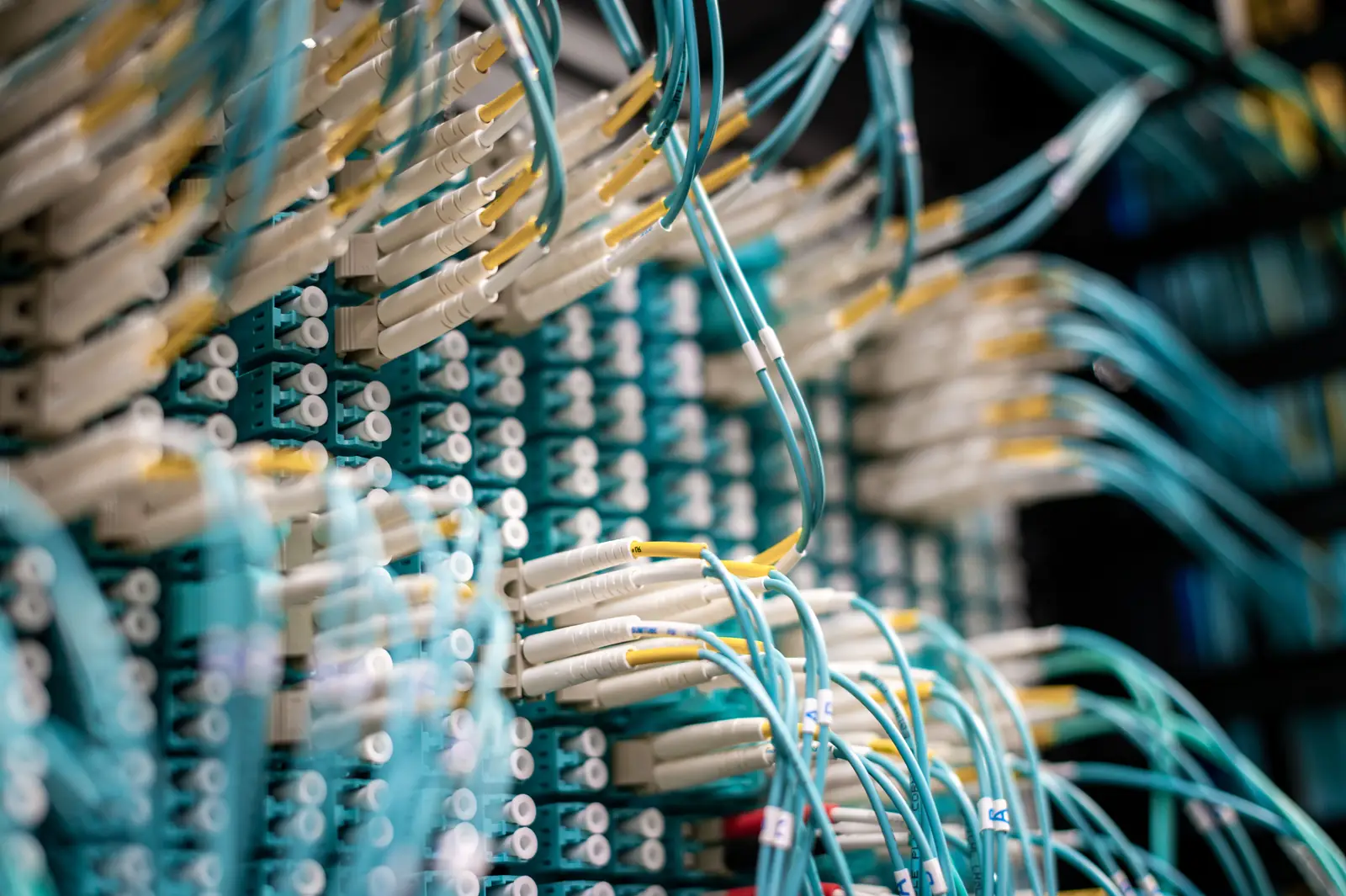
The rack is where it all comes together
A patch panel with clearly labeled, properly terminated runs and organized cable management is what keeps a system serviceable years later, not just on install day. Rack power matters too: a PDU distributes power to the equipment in the rack, while a UPS keeps that equipment running (and conditions the power) through a short outage - they do different jobs and most commercial racks benefit from both.
Power over Ethernet, briefly
PoE delivers both data and power to a camera or reader over the same cable, which simplifies installation and wiring. How many PoE devices a switch can actually power depends on its power budget, and how reliably that power reaches the device depends on cable length, quality and installation. Dense bundles of PoE cable can generate meaningful heat, which is one more reason proper cable management and pathway planning matter.
Planning for growth
Leaving spare capacity in conduit and cable pathways during the initial build is far cheaper than opening walls again later. Redundant fiber uplinks are worth considering for sites where network downtime is costly, though not every installation needs or includes that redundancy.
See our structured cabling and network infrastructure page for what we install, or our guide to PoE security cameras for more on how cameras specifically use this cabling.
Planning a project in Newmarket or the Greater Toronto Area? Contact Pitbull Security Solutions or call 647-895-1815 (answered 24/7) for a consultation.